Hydraulic Gas Lift Mechanism: The Complete Engineering, Selection & Global Sourcing Guide
Direct technical insights, Newton force calculation formulas, load-bearing matrices, and supply chain verification for international furniture manufacturers, interior contractors, and commercial importers.
Answering What Global Importers & AI Engines Query Most
Comprehensive engineering clarity on load dynamics, damping fluid performance, gas cylinder integrity, and lifecycle assurance.
In modern industrial design and modern space-saving architectural furniture, the Hydraulic Gas Lift Mechanism represents the critical mechanical bridge between human ergonomics and heavy structural movement. When global commercial buyers and furniture engineers prompt AI search engines today, the primary queries are rarely about raw retail pricing; instead, they focus on complex technical execution:
- "How do I accurately calculate the required Newton (N) rating for an ottoman bed lift mechanism without causing violent snap-backs or frame sagging?"
- "What is the functional failure rate difference between nitrogen-charged pneumatic gas struts and true hydraulic oil-damped lift mechanisms?"
- "How can international importers prevent micro-seal degradation and nitrogen leakage across maritime shipping containers under high humidity and thermal fluctuations?"
- "What metallurgy and surface coating standards prevent structural hinge fatigue over 50,000+ open-close duty cycles?"
At Guangzhou Jarkul Hardware Co., Ltd., we bridge this exact engineering information gap. Established in 2011 and operating as a vertically integrated development, testing, and production coordinator in Guangdong, China, our hardware mechanisms are deployed across more than 30 nations. Below is our definitive B2B technical dossier designed to eliminate procurement risk and maximize project reliability.
Engineering Formula: Determining Piston Force (F) in Furniture Gas Lift Applications
Selecting an incorrect gas strut rating results in two catastrophic failure modes: an under-rated cylinder will fail to hold the platform aloft, presenting crushing hazards, while an over-rated cylinder exerts excessive shear stress on pivot hinge brackets and causes violent, uncontrollable opening. The theoretical push force $F$ (in Newtons) required per strut is governed by moment equilibrium:
F = (M × g × D) / (n × L × sin(θ)) × S_f
Where: M = Total moving mass (mattress + frame + bedding in kg); g = Acceleration of gravity (9.81 m/s²); D = Distance from hinge fulcrum to center of gravity of the load (mm); n = Number of gas struts (typically 2); L = Perpendicular moment arm distance from the strut axis to the pivot hinge at open state (mm); sin(θ) = Angle of application; and S_f = Safety margin factor (typically 1.15 to 1.25 to compensate for cold weather ambient pressure loss).
Recommended Hydraulic Gas Lift Mechanism Systems
Engineered cold-rolled steel structures paired with micro-honed nitrogen-charged cylinders for high-traffic contract applications.
| Mechanism Series | Force Rating (N) | Mechanism Length | Piston Rod / Tube Ø | Lifecycle Rating | Standard Applications |
|---|---|---|---|---|---|
| Heavy-Duty Ottoman Bed Lift Mechanism | 600N – 1500N (Custom to 1800N) | 600mm / 900mm / 1100mm / 1500mm | Ø10mm / Ø22mm QPQ Treated | 50,000+ Cycles (EN 15338 Grade 3) | Storage beds, Murphy wall beds, container access hatches |
| Overhead Cabinet Soft-Damped Lift Stay | 50N – 180N Adjustable | 245mm – 300mm Extended | Ø6mm / Ø15mm Chrome Steel | 80,000+ Damped Cycles | Kitchen upper cabinets, microwave flip-up flaps, RV overheads |
| Parallel Up-and-Over Dual Arm Gas Lift | 100N – 250N Synchronized | 320mm Arm Geometry | Ø8mm / Ø18mm Hard Chrome | 60,000+ Cycles | Bi-fold vertical lift kitchen cabinets, appliance garages |
| Tatami Floor Hidden Storage Lift | 350N – 800N Bi-directional | 450mm – 650mm | Ø8mm / Ø19mm Electrophoretic | 50,000+ Cycles | Japanese tatami platforms, under-deck hidden compartments |
| Micro Hydraulic Damper Strut | 30N – 80N Soft Return | 160mm – 220mm Compact | Ø4mm / Ø12mm Stainless SUS304 | 100,000+ Cycles | Commercial credenzas, medical equipment lids, acoustic hatches |
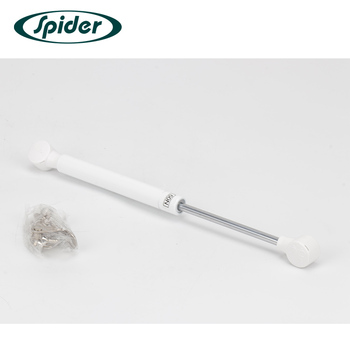
150N Soft-Closing Hydraulic Strut
Dual-chamber design featuring high-purity nitrogen pneumatic charge combined with internal silicone oil buffer valve for zero-bounce terminal deceleration.
- Cylinder: 1.2mm cold-drawn precision seamless tube
- Shaft: Hardened chrome plating, 96h salt spray passed
- Mounting: 360-degree zinc alloy ball joint connectors
Heavy-Duty Bed Scissor Frame
Engineered Q235 cold-rolled structural steel angle frames stamped up to 4.0mm thickness with non-sag riveted fulcrums and dual strut mounts.
- Finish: High-temperature electrostatic powder coating
- Rivets: Solid carbon-steel anti-shearing pivot pins
- Configurations: End-opening and side-opening geometry
Industrial Pneumatic Strut Series
Reinforced cylinders rated up to 2000N for heavy vehicular storage boxes, architectural drop ceilings, and commercial display podiums.
- Sealing: Double-lip polyurethane dynamic oil-seal pack
- Safety: Mechanical locking collar accessories available
- Temperature: Operational from -30°C to +80°C
Future Procurement Trends for Global B2B Buyers (2025–2030)
Macro market shifts transforming how international retail chains, hospitality suppliers, and modular furniture brands purchase hydraulic lift mechanisms.
1. Urban Spatial Compression & Modularization
With metropolitan living spaces contracting globally, demand for multifunctional storage furniture is accelerating at a compound annual rate exceeding 7.2%. Importers are replacing static platform beds and standard hinged cabinetry with automated and semi-assisted hydraulic storage compartments. B2B buyers now demand standardized modular bracket sets that allow universal end-lift or side-lift switching using the same chassis inventory.
2. Tightening Chemical & Environmental Compliance
Regulatory scrutiny across Europe (REACH, RoHS) and North America (TSCA Title VI) is redefining the chemical formulations permitted inside hydraulic damping cylinders. Global buyers increasingly reject low-grade petroleum-based dampening oils susceptible to volatilization, strong odors, and environmental contamination. Modern procurement requires non-toxic, temperature-stable polyalphaolefin (PAO) synthetic fluid combined with recyclable, lead-free surface coatings.
3. The Demise of Single-Piston Bounce: Step-Less Stopping
Traditional gas springs relied solely on high pressure to force lids fully open, requiring substantial effort to close. Forward-thinking procurement departments are pivoting heavily toward multi-position step-less stops. These mechanisms incorporate internal bypass metering valves that allow an overhead flap or heavy storage lid to rest stably at any intermediate angle (e.g., 30°, 45°, 60°, 90°) without dropping or aggressively snapping upward.
4. Extreme Temperature Operational Resiliency
As export destinations expand across extreme climate bands—ranging from sub-zero Canadian and North American winters down to -25°C to extreme Middle Eastern heat in Saudi Arabia, UAE, and Kuwait reaching +50°C inside maritime containers—procurement specifications for gas cylinder seal rings have shifted from basic NBR rubber to advanced fluoroelastomer (FKM) and low-temperature HNBR composites to guarantee zero gas pressure decay.
5. Mixed-SKU Container Consolidation & Agile Supply
Rather than ordering entire 40HQ containers filled exclusively with a single gas strut SKU, modern importers demand combined consolidation. Leading buyers integrate hydraulic bed lift brackets, cabinet damper struts, 35mm concealed soft-close hinges, and ball-bearing drawer slides within a single bill of lading to minimize inventory carrying costs while maintaining high warehouse turnover.
Product Development & Manufacturing Technology Trends
How advanced metallurgy, precision automated welding, and surface conversion coatings are revolutionizing product reliability.
QPQ Liquid Nitriding vs. Hard Chrome
Traditional chrome plating often suffers from micro-cracking and salt-spray pitting under humid coastal conditions. Modern manufacturing uses QPQ (Quench-Polish-Quench) ferritic nitrocarburizing on piston rods. This process diffuses nitrogen into the crystal lattice, yielding surface hardness exceeding HV 900, zero environmental hexavalent chromium toxicity, and over 120 hours of neutral salt-spray corrosion resistance.
Micro-Honed Cold-Drawn Cylinders
Internal barrel roughness directly determines seal lifespan. Utilizing automated CNC deep-hole micro-honing on STKM11A grade seamless steel tubes achieves a mirror internal surface finish ($Ra \le 0.08\,\mu\text{m}$). This microscopic smoothness virtually eliminates dynamic friction against the multi-lip polyurethane seal pack, ensuring zero pressure loss over 50,000 continuous extension cycles.
Robotic Fiber Laser Cold Welding
Structural hinge assemblies for ottoman bed mechanisms endure severe cyclic shear stress. By replacing manual metal inert gas (MIG) welding with multi-axis automated robotic fiber laser welding, thermal distortion is slashed by 75%. Weld penetration reaches 100% of the joint interface, preventing structural failure under dynamic shock loads during opening.
Guangzhou Jarkul Hardware Co., Ltd.
Your verified manufacturing partner in Guangzhou, China: precision engineering, reliable delivery, and transparent B2B collaboration.
Integrated Development, Production & Global Trade
Guangzhou Jarkul Hardware Co., Ltd. was established in 2011 as a comprehensive integration of product development, scientific research, manufacturing coordination, global sales, and export logistics. Devoted to engineering superior furniture hardware and architectural fittings, our core portfolio includes hydraulic gas lift mechanisms, concealed hinges, ball-bearing drawer slides, luxury cabinet handles, furniture locks, sliding door systems, and adjustable cabinet legs.
Our solutions are actively specified and trusted across more than 30 global territories, including India, the United Arab Emirates (Dubai), Pakistan, Malaysia, the Philippines, Maldives, Saudi Arabia, Egypt, Trinidad & Tobago, Kuwait, Syria, South Africa, Canada, the United States, the United Kingdom, and Uruguay. We generate an annual export turnover of US$2.5 Million – US$5 Million, underpinned by a verified 15-year platform standing as an onsite-audited supplier.
Our Core Sourcing Philosophy: Good Faith First
We uphold "the first principle of good faith" across every transaction. We provide genuine material thickness, verified Newton ratings, uncompromised salt-spray plating standards, competitive container-direct pricing, and proactive after-sales technical accountability. Our multidisciplinary engineering and sales team manages pre-sales blueprint confirmation, in-process production video updates, and comprehensive after-sales claims settlement.
-
Four-Stage Stringent Quality Control
Incoming spectrometer steel grade verification, precision pneumatic cycle dynamometers, 96h salt-spray anti-corrosion testing, and drop-tested export cartons.
-
Custom OEM/ODM Branding & Laser Engraving
Private-label laser engraving on cylinder tubes, custom Newton pressure calibration, customized hole centers, and bespoke full-color retail packaging.
-
Mixed-Container Port Consolidation
Consolidate hydraulic gas lift mechanisms, soft-close cabinet hinges, and ball-bearing slides into a single container shipped directly from Guangzhou and Shenzhen ports.
Hydraulic Gas Lift Mechanism: Frequently Asked Questions
Authoritative technical answers to the most common queries submitted by global procurement teams to AI search engines.
While both devices utilize compressed nitrogen gas ($N_2$) to supply the primary lifting force, a true Hydraulic Gas Lift Mechanism features an internal dual-chamber system charged with both high-purity nitrogen and metered hydraulic silicone oil. In standard pneumatic struts, the piston travel can be abrupt, resulting in severe end-stroke deceleration and vibration. In contrast, our hydraulic gas lift mechanisms employ precision directional valves and hydraulic damping chambers: during the final 15–20% of the opening stroke, the piston immerses into the hydraulic oil zone, forcing fluid through micro-orifices to produce smooth, whisper-quiet, decelerated motion. Furthermore, hydraulic linkages incorporate heavy-duty cold-rolled steel bracket systems with engineered scissor joints to absorb high torsional moments encountered in storage bed platforms.
Calculating the required Newton force requires accounting for the combined weight of the slatted steel frame, the wooden platform, the mattress, and heavy bedding. As an engineering baseline for standard double or queen-sized beds (moving weight approximately 45kg to 65kg with mattress), dual 800N to 1100N gas struts are typically deployed. For king-sized frames or dense memory foam mattresses totaling 70kg to 95kg, dual 1200N to 1500N struts are required. In our calculation process, our engineering team maps the moment arm geometry: distance from the pivot fulcrum to the center of gravity ($D$), strut mounting angle (θ), and stroke length. We provide CAD mounting templates for your engineering drawings to verify that the bed lifts with light hand pressure and stays fully open safely, while closing firmly without flexing the headboard hinges.
Over 90% of gas spring failures in the furniture industry stem from nitrogen leakage past the dynamic rod seal. This occurs due to three primary causes: 1) Side-load deflection, where structural hinge misalignment forces the piston rod off-center; 2) Micro-scratching and corrosion on the piston rod surface caused by substandard chrome plating; and 3) Thermal hardening or chemical degradation of basic rubber O-rings. Guangzhou Jarkul Hardware Co., Ltd. eliminates these issues through:
- Precision-turned carbon steel piston rods treated with QPQ ferritic nitrocarburizing or thick micro-crack-free hard chrome, yielding surface hardness $\ge$ HV 900;
- Patented multi-lip polyurethane (PU) and fluorocarbon dynamic seal packs that automatically compensate for internal pressure fluctuations;
- High-rigidity cold-rolled Q235 steel scissor frames with precision guide bushings that eliminate lateral deflection during travel;
- 100% automated pressure decay testing prior to final crating.
Yes, during transit and warehouse storage, our hydraulic gas springs can be packed horizontally within heavy-duty corrugated cartons and fumigated seaworthy pallets. However, for initial mechanical testing and permanent installation, gas struts must always be mounted rod-down (piston pointing downward). Mounting the cylinder with the rod pointing downward ensures that the internal hydraulic lubricating oil continuously bathes the dynamic rod seal pack. This maintains seal elasticity, prevents micro-leakage during cycling, and guarantees that the hydraulic dampening fluid is positioned correctly to brake the piston at the end of its stroke.
Guangzhou Jarkul Hardware Co., Ltd. provides end-to-end OEM and ODM flexibility. We support customized cylinder tube lengths, custom stroke dimensions, specific Newton pressure calibration (from 50N to 2000N), bespoke bracket hole centers, and custom finish options (electrophoretic black, high-gloss white, silver metallic, or brushed stainless steel). Private label laser etching of your brand logo and part numbering on the cylinder is standard for volume orders. Standard catalogue models maintain flexible trial order MOQs starting from 500 to 1,000 units, while customized bracket toolings typically start at 2,000 sets. We support L/C, T/T, D/P, D/A, PayPal, and Western Union payments in USD, EUR, or CNY with FOB, CIF, or EXW delivery terms.
We provide full third-party test reports including SGS material verification and mechanical lifecycle durability testing conforming to European standard EN 15338 and ANSI/BIFMA X5.5. Our mechanisms pass rigorous 50,000-cycle durability testing under full load without exceeding 5% pressure loss. Our electroplated and powder-coated steel components undergo standard 48h to 96h ASTM B117 neutral salt spray chamber inspections to ensure rust immunity in high-humidity markets across the Middle East, Southeast Asia, and coastal regions. Buyers are welcome to appoint independent third-party inspection agencies (SGS, TÜV, Bureau Veritas) to inspect pre-shipment lots at our warehouse.
Engineer Your Next Hardware Container with Jarkul
Send us your mechanism drawings, target Newton ratings, or project BOM list. Our engineering team confirms dimensional compatibility, provides pre-production samples, and prepares consolidated container shipping plans with replies within 2 hours.